24/7 Hour
-
-
-
Delhi • Gurugram • Ahmedabad
24/7 Hour
Delhi • Gurugram • Ahmedabad
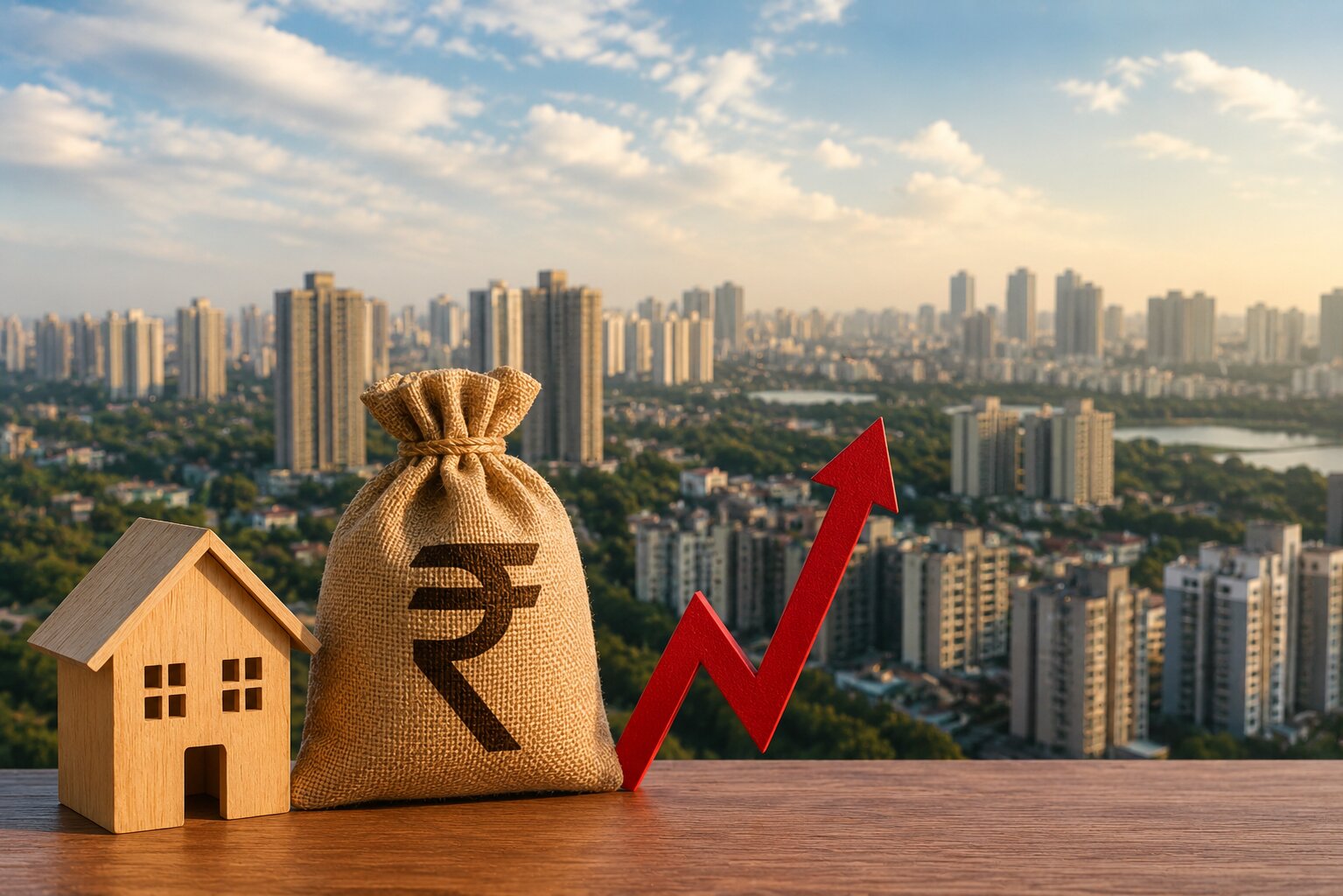
Housing Sales Drop 14% in the Top Seven Cities of India in 2025. Yet property prices kept rising. That gap is driving one of the biggest search trends in Indian real estate: is a real estate crash in India finally coming?
This page is for buyers, investors, and renters making decisions in an unpredictable market. If you are weighing whether to buy now, hold off, or move cities — you need facts, not fear.
Volumes of housing sales, India's housing bubble discussion, affordability concerns in Mumbai, and other specific market scenarios. All facts presented below are based on reports of Knight Frank, JLL, NHB, and RBI.
No. A nationwide crash is not happening. Volumes declined by 14% in 2025, while transaction value increased 6% for higher prices but lower volumes. Re-pricing is ongoing in the high-end segments of the market; however, demand for mid-income properties remains soft.
This explains the fall in volume of transactions: the push towards developing non-affordable housing. Construction of high-end properties increased by 169% YOY in 2024, whereas luxury property construction rose by 116%. Supply moved up-market. Buyers who could not follow stepped back.
📊 The result is a two-tier market. High-net-worth buyers and institutional investors continue transacting at record prices. First-time buyers and mid-income households are priced out—not because prices crashed, but because they never corrected in their segment.
Price Rise in Major Cities (2019–2024)
Average Annual Income Growth
Housing Sales Decline in 2025
NCR Sales Decline (Steepest in Top 7)
The housing bubble India fear is grounded in a specific data point: India's GDP per capita is $2,200 — yet Mumbai property prices now compete with cities in the US and UK, where per-capita incomes are 30–40x higher. That ratio is what triggers bubble comparisons.
According to The Times of India in 2025, it will take 109 years for the top 5% of the Mumbai population to save enough to purchase housing in the city. Gurgaon: 64 years. Bangalore: 36 years. Delhi: 35 years.
⚠️ The Mumbai EMIs-to-income ratio reached 47% in 2025. The affordability barrier according to Knight Frank is 50%. Mumbai is 3 percentage points away. In practice, most Mumbai households already feel that ceiling.
This is the engine behind every 'india property bubble' search. The frustration is not speculative — it is a mathematical reality for anyone trying to enter the market below the luxury tier.
Affordable housing inventory fell 70% in Hyderabad, 60% in Mumbai, and 50% in NCR over the two years to 2025. That is not a coincidence — it is a policy outcome driven by developer margin calculations.
Example: a first-time buyer in a big city like Bangalore in 2025 faces roughly 25% fewer sub-₹50 lakh options than in 2021. The units exist on paper. They are simply not being built.
Serious analysts are not predicting a crash. They are predicting stagnation — flat or marginally declining prices in overheated zones over 2–3 years. A 10–25% correction in specific luxury micro-markets is the realistic downside scenario, not a 2008-style collapse.
Investment banker Sarthak Ahuja stated directly in October 2025: 'No crash, just stagnation.' His analysis aligns with JLL's Q4 2025 residential dynamics report, which showed volumes down 11% but INR 1 crore+ apartment sales up 6% year-on-year.
Here is why a structural crash is difficult in India's specific market:
💡 For buyers, this matters: prices will not fall by 30–40% while you wait. But negotiating room has opened up in volume-pressured markets. That window is real and time-limited.
With sales down 14% in 2025, buyers hold more negotiating power than at any point since 2020. Developers in NCR and mid-Mumbai are quietly offering 5–10% discounts and deferred payment plans. That leverage disappears when volumes recover.
One area that is commonly associated with attracting investor interest is the Dholera Smart City of Gujarat.
Dholera is known as the first Greenfield Smart City of India and is also an integral part of the DMIC or Delhi Mumbai Industrial Corridor. As compared to other mature urban markets whose prices have appreciated considerably in value, Dholera is in the developing stages.
It is being developed through significant infrastructure investments such as expressways, industries, utilities, and connectivity. Such investments are aimed at fostering the growth of industries, businesses, and even urbanization.
📌 Many investors view investing in Dholera as a form of land investment in the long term. Although there are no guarantees in investments, areas where there is investment from government infrastructure are more popular.
The property investors who have been successful in their venture are paying more attention to fundamentals rather than to sentiment in the marketplace.
They look at the development of infrastructures, economic activity, investments in industries, transportation networks, population, and other long-term factors that create demand.
Instead of hanging around hoping for a collapse of the market countrywide, they are looking at areas where development will bring sustainable gains in the future.
Our company, Vishal Landbase Pvt. Ltd., works towards providing our clients with detailed information related to the plots and lands associated with the Dholera Smart City project.
At Vishal Landbase Pvt. Ltd., we track all updates regarding development, infrastructure, TP schemes, activation zones, industrial growths, and connectivity projects in relation to the Dholera city.
We at Vishal Landbase Pvt. Ltd. feel that transparency must be maintained with respect to all our clients when it comes to information regarding land investments. Instead of giving false and unreal expectations, it is essential for us to make the buyer aware of all opportunities and risks associated with the land investment.
No matter what kind of land investment, we ensure that our clients make wise investment decisions through proper counseling.
Present data indicates that there will not be any kind of crash occurring in the real estate market in India. In some markets, there might be an occurrence of a slowdown due to excessive enthusiasm in such markets; however, the overall market will still receive support in terms of housing demands, urbanization, economic development, and infrastructural Development.
The most crucial consideration for the buyer and investor, therefore, is not whether a crash will occur, but where opportunities lie in the future.
Some examples of such places include locations based on infrastructural development, industrial corridors, and even planned developments such as Dholera Smart City.
Explore Verified Investment Opportunities in DholeraGet information on various plots at affordable prices from Vishal Land Base.
In 2025, a broad price fall is unlikely. Most analysts expect flat growth or mild stagnation in 2026. Overpriced luxury micro-markets may correct 10–25%. End-use demand and a 10 million home shortfall prevent a nationwide price drop.